Showing posts with label theology. Show all posts

22 October 2009

Sacrifice

So, a few years ago I was challenged by a definition of sacrifice that has had me scratching my head since.

sacrifice: giving up something of great value for something of lesser value

This gives a greater understanding of Christ's sacrifice for us (the righteous for the unrighteous, God for man, the Prince of Glory for sinners), but on another level, it brings up so many questions! With this definition, is it truly possible for us to sacrifice anything for Christ? What we give up is worth so much less than what we gain, that is it truly any kind of sacrifice? Yet, we are clearly told that God delights in our sacrifices. This has been a great puzzlement.

We discussed I Peter 2:1-5 with a small group of folks from church and the confusion began to be cleared away. Drew and I discussed it more as we drove home and I think I've got a much better handle on it.

I think there's a place for the above definition on a horizontal level, and when we think of the Lord sacrificing himself for us, but it falls short when we think vertically in an upward direction.

Horizontally: we must ask ourselves if we're really sacrificing when we want to think we are. If a mother says that she sacrificed her career for her children, isn't she really saying that her career was the more important of the two? If I claim to sacrifice my time in order to educate my children, aren't I really valuing my time above my children? Am I proud of my sacrifices? Hmmm … questions to consider.

Vertically: the sacrifice the Lord demands of us isn't based on any kind of valuation of what's offered (that's because of his grace in receiving our meager, dirty-rag offerings, not because our offerings are so high and valuable). Rather it's based on the fact that, biblically, sacrifices are dedicated totally to the Lord. When we're told to offer ourselves as living sacrifices, Paul isn't implying that we're more important that what we get in return, relationship with the Lord and the opportunity to glorify him; rather that we should wholly devote ourselves to serving and glorifying the Lord. It's about whole-hearted dedication, devotion, and passion for Christ.

And, to loosely paraphrase John Piper, as we serve Christ, we also enjoy him, which brings him the most glory.

SDG!

11 February 2009

Vocational Reading: General & Marriage

I originally set up a list of 'vocational' books that have had an influence on me through the last 20 years, but the list ended up being absolutely huge.  I decided that it might be better if I divided the list out by topic. Some of these may be considered 'controversial', and you may not agree with everything written on every page, but that's okay. They've all had a rôle in shaping me. I hope to add to these lists as time goes by.

Womanhood in general:

Recovering Biblical Manhood and Womanhood, by John Piper and Wayne Grudem
Discipline: The Glad Surrender, by Elisabeth Elliot
Feminine Appeal, by Carolyn Mahaney
Lies Women Believe and the Truth That Sets Them Free, by Nancy Leigh DeMoss
The Way Home: Beyond Feminism and Back to Reality, by Mary Pride
Missing From Action, by Weldon Hardenbrook (primarily for and about men, but his discussion of the industrial revolution's effects on the family and the subsequent rebellion of feminists against something that was much different than biblical womanhood is spot on and eye-opening.)

Marriage:

When Sinners Say 'I Do', by Dave Harvey
Love That Lasts, by Gary and Betsy Ricucci
On Marriage and Family Life, by Saint John Chrysostom (haven't read this yet, but it's sitting in my Amazon cart and the author comes highly recommended ;-D)


NB: if you decide to purchase any of these books, please put it in your Amazon cart directly from the link given. If you go to another page and come back to the item, it will no longer have my associate's code linked to your purchase. I've been an Amazon associate for a couple of years (meaning I receive a small percentage of every purchase of items I've linked to) and have yet to receive anything.

Coming up next: lists about Motherhood, Home Education, and Housewifery

SDG!

24 January 2009

The Mother and Her Reading, II

Most of CJ's focus was on spiritual growth, developing an affection for the Saviour; as we read, so we think and as we think, so we feel.  In order to develop passion for the gospel, we must be reading books about it, books that will help us look at it freshly and to see new aspects of it.  We must strive never to grow familiar with the gospel.

So the first category of our reading must be books that care for our souls. Scripture is a no-brainer, but also we should be reading books that challenge us spiritually to examine our hearts, books that remind us freshly of the gospel, books that help us get a firm grasp on solid theology. Not all at once, but they should be part of the plan.

This applies to every believer. Yet it applies to moms at home because it affects our children as well as ourselves.  In a very real sense, we are pastoring and discipling our children as we raise them. Their souls must be a focus of our efforts. However, we cannot give them something we don't have. If Mom isn't experiencing a deepening faith and relationship with Christ, she can't pass that onto her kidlings, nor will she be quick to walk in dependence on the Lord. (Yes, Dad is the head of the family and ultimately responsible before the Lord for child-rearing efforts, but most moms spend more time with their children than dads do; we must be working along with our husbands, following their leadership, submitting to their goals; but often the time, effort, and day-to-dayness of raising children falls on our shoulders, not as a burden, but as a privilege.)

CJ also, rightly placed a specific emphasis on books about our specific callings. For those of us whose calling is to keep house and raise our children, this would include books about being a godly wife, a joyful mother, a skillful teacher. 

Books to help and encourage us in our home making activities: cooking, gardening, household organization, home crafts (sewing, knitting, crocheting, tatting, things that make a home and a life beautiful), the theology and philosophy of keeping house (there are many voices telling us that we are wasting our lives by devoting it to drudgery - we must remind ourselves of the truth of the high calling to which we aspire so that we don't grow weary in well-doing), leadership, bargain hunting, hospitality, cleaning tips, caring for the sick and elderly. The list goes on and on.

Homeschooling moms would also benefit from reading books about educational philosophy and practice as well as literature, history, biographies, logic, science, even some math books. Part of this is to equip us to help our children learn, but this type of reading also keeps our minds sharp. We may not remember everything we read, but we'll be much better able to point our children to books that will benefit them and we'll be able to discuss them together.   It is also an excellent example to our children of the joy of a lifetime of learning.

My intent isn't to overwhelm anyone by these lists of possible topics for us to read about.  I point them out so that we can be intentional in our reading choices.  I certainly don't read all these types of books at one time.  I have certain areas in which I lack skill or motivation and  I need to be reading books about those topics (my current focus in school is books about writing and teaching writing).  There are also certain areas of particular gifting or topics that appeal more to me than others; those are books I want to read.  These lists are more suggestions to get you thinking about your reading.  It's better to start anywhere and read one at a time than to feel so overwhelmed that one never starts.  I hope these lists lend themselves to a lifetime of reading.

Teddy Roosevelt said that those who read will be those who lead.  We live in a post-literate society.  It's not that people don't know how to read (although they may not have been taught how do it well), but that they don't see the importance of reading; they choose not to read.  We may feel that we're at home, not out leading in our culture, however, cultural change happens the way yeast works in bread.   'A little leaven leavens the whole lump,' is how Christ described the church.  Chesterton said that there is nothing more powerful than an average man and his average wife and their average children living their average lives to the glory of God.  Reading can help us do so, and do so well.

Next time, I'll list specific books that I've found helpful and that I think are worth reading and re-reading.

SDG!

10 January 2009

Blogging and Keeping House: The Litany of Everyday Life

My friend Carol blogged about why she blogs and asked her blogging readers to tackle the same question. She had some great thoughts about it and got me thinking.

1) Blogging helps me think more clearly. As I work to get my ideas into a form that others can understand, I refine them.

2) I need the practice writing.

3) I aim to be an intelligent, hopeful, joyous voice standing for biblical womanhood and all it encompasses: submission to my husband, joyfully teaching my children, working with creativity to make a comfortable home from which my family can serve the Lord and others. There are so many strident voices denouncing anything less than paid work and overreaching ambition in wives and mothers that there needs to be someone speaking the truth. I may not be a loud voice, but many small voices might have an influence.

4) Not only do I hope to speak truth in a hostile culture, but I hope to be an example to younger women and an encouragement to women my age and older. I don't read many blogs, but the few that I do read regularly encourage and sharpen me. It would be a privilege if my writing did the same for others.

5)  I hope to leave a written record of my thoughts for my children, a legacy for future generations.


In light of these reasons for writing, I'd like to recommend another book.

I recently re-listened to CJ Mahaney, Jeff Purswell, and Josh Harris discussing 'A Pastor and His Reading'. While I'm not a pastor, there was much food for thought there. One realization I came to is that, as a wife, mother, and home educator by calling, I should regularly include books about these callings in my reading diet (more in later posts about some of the other observations I've drawn from this whole series of podcasts).

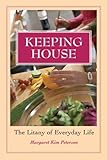
Then a friend recommended this gem:


I nipped over to Amazon.com and was pleasantly surprised when my package arrived the next day.  (Amazon's two-day shipping is great!)

As I read it, I was refreshed in my vision of making a home and all that it means.  This isn't a list of practices and techniques, but a theological and philosophical defense of, well, keeping house.  Margaret Kim Peterson reduces keeping house down to Christ's commands to provide food, clothing, and shelter in his name.  However, while she reduces and simplifies the scope of keeping house to these three areas, she doesn't reduce their importance; she makes them larger. 

She also turned to Psalm 104.  As I read the excerpt through tears, I saw the Creator of the universe keeping his creation, putting it in order, providing for life and comfort -tasks that we see as drudgery and mundanity, yet the Lord himself does these things.

I came away from each chapter with a new appreciation of the work I've been called to. I've also realized that there are ways of thinking and talking about them that need to change. By the Lord's grace, I'm making these changes and I think that will be helpful in maintaining this new focus (more about that in later posts, too).

Not only was the content enlivening and inspiring, but the writing itself has an appealing, lyrical quality.  It was a joy to read and re-read.

SDG!