Showing posts sorted by relevance for query yogurt. Sort by date Show all posts

26 September 2011

Yogurt, My Final Word

I've been asked about my yogurt process lots of times since my series about what I learned in my yogurt journey. I usually send people a link to a Google search of my blog and 'yogurt'. But last night, a good friend said that she always does better if she can see the process, so here it is, all pulled together into one post and with pictures!

This makes a gallon of yogurt (unstrained). I'll include variations throughout.
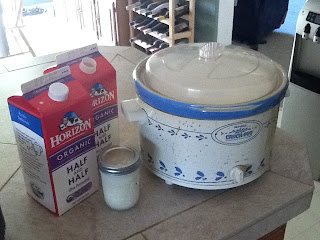


We start by pouring a gallon of half-n-half or heavy cream (when it's on sale) into the crockpot, set on low.


If we've forgotten to pull our starter (in this case, a small jar from our last batch that was put into the freezer) out the night before to thaw in the fridge, we place the frozen jar next to the hot crockpot to defrost.


Once the half-n-half/cream reaches between 112˚ and 120˚ (about an hour and 20 minutes for us, but your mileage may vary), we fill empty, clean jars with hot tap water to warm up (like filling a teapot with boiling water to warm up before actually making tea with a fresh infilling of boiling water and tea). While the jars warm up...


...ladle some of the hot cream/half-n-half into a measuring cup or a deep bowl.


Pour in the thawed starter.

If the starter is still very cold, the cream can be on the higher side of the temperature range. If using Yogourmet starter (one envelope works great for a gallon of yogurt; I've seen recipes that call for four envelopes for a half-gallon of yogurt -- what a waste!), store-bought, plain yogurt, or we did remember to thaw our frozen started the night before, we aim for the lower side of the temperature range.

I'd like to try a cup of plain, store-bought Greek yogurt as a starter, as I've heard it has more kinds of cultures.

Once the starter thaws, it gets thin and runny, but never fear. The cultures are fine and the yogurt should thicken without a problem. If it doesn't, it's not because of the frozen and thawed cultures. Freezing it keeps it fresher longer and you'll be able to get more batches out of each starter before it goes sour, saving money.


Whip it up until there are no lumps.


Pour back into the crockpot.

If you want to add flavoring, it can go in now. I keep ours plain so we can each flavor it individually or I can use it in Silky Buttery Chicken to marinate the meat (see the link below!).


Fill the warmed and dried jars with the cream/half-n-half and cultures mixture and put the lids on. Don't forget to wash, warm, and re-fill your starter jar!

You could probably add different flavors to each jar.


Put them under a thick bath towel or two on the counter to culture.

I used to use four quart jars plus the small jar, but we've been using our quart jars for so many other things lately that I'm running out. Once we replenish our supply, I'll go back to the four quart jars. They fit into our fridge better and my husband takes one to work for snacks there. They also hold the heat better, but the yogurt still comes out thick, even in plastic containers.


After four or five hours, it's nice and thick. Into the fridge it goes to chill.

If it hasn't thickened up after that amount of time, I'll put a heating pad under the jars under the towel and turn it on low or medium for 20 minutes to a half hour. That always seems to do the trick.

This is a good time to strain it for thicker, more Greek-like yogurt. I'm out of cheese cloth now, but want to try this in the near future. I'll try to strain it overnight in the fridge to get out all the whey.


Here it is! Nice and thick and creamy, topped with fresh blueberries.

Since I'm not baking anymore, I've been throwing the whey away, but now that I'm trying some low-carb baking, I may save it and experiment with the new recipes.


SDG!

29 April 2009

Yogurt Revisited

Yes, another post about yogurt!

Why do I keep reading others' yogurt recipes?  Because I just might learn something new.  Well, I think I have.

A couple weeks ago, after the yogurt was done and ready for the fridge, I discovered that I didn't have any quart jars clean.  We had room in the fridge ('Wonder of wonders! Miracle of miracles!'), so I put the whole 1-gallon crock in.  The next day, the yogurt was the thickest I've ever seen (yes, even thicker than store-bought with all its gelatins and guar gums).  We ate it from the crock in the fridge until it was time to make more (it helped that I have two crockpots - I'm 'bi-potal' according to my friend Renee).  I did the same thing with the next batch of yogurt to see if this was a fluke or a discovery - put the whole crock in the fridge, and again, it turned out super-thick.  I thought I was onto something, but unless I assumed all my readers (all 10 of you) are also bi-potal, this wasn't a tip for public consumption.

'So why am I posting this publicly?' you ask.  Good question.  This morning, I was reading Strategic Eating: The Econovore's Essential Guide by Elise Cooke (review coming soon) and she outlined her process for making yogurt.  Honestly, the crockpot is much easier as far as I'm concerned, but she included a step that put the final piece into my yogurt puzzle and that makes this a tip everyone can use.  

After adding her cultures, Elise pours the liquid into jars and then she warms the jars in a hot water bath or in a slow oven.  Well, being the tea connoisseur that I am, I know that no pot of tea is worth its weight in tea leaves unless it's been pre-heated by pouring boiling water into it (and then emptying it) before putting in tea leaves and more boiling water.  Put these two things together and I think I've found an easier way to make my yogurt yummy and thick.

I've got half-&-half heating in the crockpot now.  When it's closer to being the right temp, I'll pour boiling water into four quart-sized jars and one half-pint jar (to hold my starter for the next batch).  I'll mix my starter in, then I'll pour the cultured liquid into the hot jars, wrap the jars in a beach towel, and let the bitty cultures grow.  Once they're firm, I'll put the jars in the fridge.

I'll report back and let you know how my experiment goes.

SDG!

16 January 2009

Tips

Just a couple of things I've learned lately.

1) If a permanent marker is used on a white board, it can be removed!  I tried a couple of different techniques and they both worked great to get the littles' French vocabulary cleaned off and neither ruined the board's finish.

a)  Take a dry erase marker and trace over the offending mark.  The alcohol in the marker dissolves the Sharpie.

b)  For larger messes, wash the board with alcohol-based hand sanitizer.  Works like a dream.

2)  Yogurt can be made in a crockpot.  I have a yogurt maker and love it, but it makes 7 6-oz jars - not enough for us and a bit hard to fit all those little jars into the fridge.

The recipe calls for low-fat milk, but I've discovered that half-n-half makes a great yogurt.  (Yogurt made with cream is called crème bulgare and is my favorite.  Half cream, half milk (or bought half-n-half) is just as thick, but less expensive.)  I made more than a half gallon earlier this week and we've been enjoying it immensely.  This recipe is easier than using my yogurt maker as it takes less of my time, even though the recipe takes longer overall.

Non-instant dried milk can also be added for a thicker consistency (I'm not sure how much you'd need for this recipe - play with it).  I make it plain and we add flavorings to our bowls.  I like mine with a small sprinkling of brown sugar, but fruit or granola is also delicious.

For those of you who are local, I purchase my cultures from Sprouts.  Or you can use a container of plain yogurt bought from the grocery store, as long as it contains live or active cultures.

Here's the recipe.

SDG!

30 April 2009

And the Results Are…

Instead of putting boiling water in the jars before pouring in the hot cultured milk, I got the tap as hot as it would go and used that.  The yogurt in the jars thickened up in the same amount of time that the crockpot usually takes and the jars stayed warm under the towel.

This morning, after spending the night in the fridge, it was thick and wonderful.  I think this technique is a winner.

Allison, I went through the grainy and thin yogurt stage and never really figured out why (sun spots?  a butterfly fluttered its wings in Hawaii?  a yogurt curse?).  I've been told that making yogurt is more an art than a science.  I'd let it sit a bit longer next time and see if that helps.  I also found that turning the crockpot on low for about 10-20 minutes if it was taking awhile to thicken seemed to help - at least, I think it did; if I hadn't turned it on, it might have thickened up on its own anyway--no way to tell.  (If I needed to do this with the jars, I'd put them either in a shallow warm water bath on the counter or set them on a heating pad set on low.)

Another tip from Elise - I poured about a cup of the half-&-half and starter mixture into a small jar and set it on the counter under the towel with the quart jars to thicken up.  When the yogurt had thickened, I put the small jar into the freezer.  I'll take it out and let it defrost in the fridge overnight and use that as my starter when I make it next.  This tip might make the starter last longer.  I was using an envelope of cultures every few batches, and using a half to a cup of yogurt itself as a starter in between.  Freezing it will help it remain fresh longer and therefore I can get more batches for each envelope of starter, cutting my costs even more.

SDG!

07 February 2009

Playing with Yogurt

Earlier this week I made a batch of yogurt.  After 4 1/2 hours, it still hadn't set, so I turned the crockpot on low for about ten minutes and then re-wrapped it and promptly forgot about it.  Three hours later, it had set up as firm and thick as sour cream.  It was the best I'd ever made.

I tried again yesterday, doing the same thing I'd done earlier in the week (10 minutes on low after 4 hours and then letting it go for another 2 or 3 hours).  Again, it turned out just fabulous!

Now that I'm getting a better handle on yogurt, I'm beginning to research using yogurt as the basis for cream spreads, creamy salad dressings, and recipes to use it in (as a replacement for sour cream, for example).  I'll keep you posted!

SDG!

22 January 2009

Yogurt Tweak

For those of you who've tried the crockpot yogurt recipe I posted last week, I've figured out how to make it in about 5 hours instead of the 13 1/2 hours of the original recipe.

Most yogurt instructions say that you have to heat the milk or cream very hot and then let it cool to between 110o and 115o, as did this original recipe (heat on low for 2 1/2 hours, then cool for 3 hours).  This step is included to pasteurize the milk.  However, if you're using pasteurized milk, you can simply heat the milk to the target temperature and then add your cultures.  In my crockpot set on low, with a half gallon of liquid starting at fridge temperature, that takes an hour to an hour and twenty minutes.  After checking the temperature with a meat thermometer (making sure the thermometer doesn't touch the bottom or sides of the crock!), I add the cultures, turn off the pot, and wrap it in a big beach towel.  It finishes incubating in about 4 hours, not the eight called for in the original recipe.

By doing it this way, I've cut the heating time, eliminated the cooling time, and cut the incubating time, resulting in more flexibility in my day; I can start it at noon and still be able to put it into the fridge before dinner.

Now that I know how long it takes to heat up, next time I'll be able to rely more on the clock to know when to check it.  Play with your own set-up.  The temp in your fridge and your individual crockpot may require more or less time than mine, but once you've figured it out, it should get easier from there.  And some folks think science isn't useful in every day life!

SDG!

26 January 2009

Vigilance

'The price of liberty is eternal vigilance.'  
~Thomas Jefferson
While I don't often write about history, politics, economics, demographics, or current events, I am intensely interested in them.  There are much better-informed and more logically and eloquently-written sources for this type information and philosophy than I could be, so I won't try to fill a niche that's already being well-filled.  However, I will be writing about different policies that will affect us here at home and how we're planning to respond to them. 

As we see by the signs that a storm is coming and prepare accordingly, so we must keep an eye on our world, not so that we become frightened (after all, our trust is in the Lord and his loving sovereignty), but so that we can prepare.  Better to keep watch and prepare ahead of time when possible than to scramble and try to figure out what's happening when the winds blow, lightning strikes, and hail pummels you.

In light of our current president's economic views and his emulation of FDR (whose economic policies caused the depression of the 1930's to become great), our household is preparing for very hard times.  We're watching not only current policies, but demographic trends.  As we move through the next few decades, the Baby Boom will retire and, as is usual during that season of life, will spend less, which will lead to an almost permanent drop in the stock market as consumer markets are significantly reduced.  Life for our children and grandchildren will be very different from what we've know to this point.

So, what changes are we making in the day-to-day running of our household?
  • We're cooking more from scratch.  (This includes the yogurt recipe previously posted, and making granola instead of purchasing boxed cereal - recipe coming soon! - baking more bread, making mayonnaise, and I've gotten our sprouts grower out again.) 
  • We're working to get the garden to produce again.  (We started a compost bin this weekend - Arizona soil isn't so good and we'd rather use our own free scraps and yard waste than purchase compost.)
  • We're sewing more of our own clothes (with fabric purchased at low prices on sale).  
  • I'm going to study pattern-making to give us more flexibility in clothing design and save money on expensive patterns.  
  • We've been using fountain pens for years, but we'll be purchasing more for the whole family (a bottle of ink can last for years and costs less than other pens which don't last as long).  
  • We're cutting back where we can in order to purchase tools that will make our family more productive and less dependent on public policy (for example: a knitting machine, a clothes line, wood-working tools).
  • We're learning new skills.  (The girls are learning to crochet; I'm re-learning to knit; I'm teaching the girls to sew; we hope to learn to embroider and draw and even paint; as well as the above-mentioned pattern-drafting, and Drew is teaching the boys wood-working skills.)
  • We made many of our Christmas presents this year and will continue doing that for birthdays.
  • Drew and I are going out for dessert for our date night, instead of eating dinner out.  We're also going to the movies less often.
We're not doing these things only for our family, but we hope that our preparation and work will put us into a position to minister to and help others.  Here's one example:

The new administration is planning to put into effect an energy policy called 'Cap and Trade'.  This will require local power companies to produce less electricity.  Our tax dollars will then be given to the electric companies so that they don't see a loss of revenue.  This will give us rolling blackouts and brownouts along with higher taxes.  We are working to save for solar power for our home.  When the rest of the neighborhood is sitting in the dark, we'll have light.  What an opportunity to invite our neighbors in, to share what we have, building relationships with them, and possibly having an opportunity to share the gospel.

The coming times will be challenging, but we hope to rise to the challenge in a joyful and faithful manner.

SDG!

26 July 2012

Crème Fraîche

Yes, it's been forever.  I've been posting a few things on Facebook that I realized this morning I could post here and then share on Facebook, so that's what I'll be trying to do from here on out.

For those of you who don't know what crème fraîche is, you're in for a treat!  It's a gently soured cream, not as tangy as sour cream but very smooth and very French.  In my efforts to increase the healthy fats in my diet, I've been adding a couple dollops to my scrambled eggs each morning.  Wow!

I've made crème fraîche in the past by adding a tablespoon or two of cultured buttermilk to a quart of cream and letting it sit out overnight.  The rest of the buttermilk was then used for baking.  But I'm not really baking anymore (both in avoidance of grains and in avoidance of adding extra heat to our hot afternoon house).  I bought some crème fraîche from the gourmet grocery store last week (cha-ching!).  I was almost out and I thought I'd give something a try ("I tell you, LaFou, I've been thinking." "A dangerous pasttime." "I know.").

I added a couple large dollops of crème fraîche to a pint of cream and let it sit on a kitchen counter in a mason jar for 24 hours.  It thickened up nicely, but didn't smell quite tangy enough this morning, so I let it go another 12.  I still have to decide if I'll put it into the fridge tonight or tomorrow morning, but it's smelling pretty good right now.  Even though it wasn't quite done, I used a little in my eggs this morning and it tasted great.

I'm not sure how long I'll be able to keep this up.  Hmmm…maybe if I store a couple spoonfuls in the freezer, I can use that to start my next batch, the way I keep a small jar of yogurt in the freezer as starter?  I guess I'll find out!

I've also been making water kefir - just started this week, but that's a post for another day!

SDG!

04 February 2009

Master Breakfast List

As promised, here's my master breakfast list:

bacon
eggs
toast
hash-browned potatoes (we purchase dried hash-browns at Costco)
oatmeal, Coach's or Irish
yogurt
granola
pancakes
French toast
coffee cake
banana bread
biscuits & gravy
fruit, canned or fresh
baked oatmeal
English muffins
non-English muffins
bagels

If you have any ideas to add to this, I'd love to hear them!

SDG!

06 May 2009

My Grocery Shopping Philosophy

A philosophy for grocery shopping?  Well, yeah, I think we should have a philosophy for everything - grocery shopping, furniture arranging, the way we dress - everything (whoever said caring for the home was a mindless job certainly had no idea).  

So, here's my grocery shopping philosophy.  [drum roll, please; cue the choir] 

Purchase ingredients.

Whew!  I'm glad I got that off my chest!

I'd rather have my pantry stocked with flour, oil, cocoa, sugar, vanilla, and baking soda and powder and my fridge with butter, milk, cream, eggs, and yeast than with lots of packaged mixes.  With those ingredients, I can make brownies or crépes (sweet or savory) or yellow cake with chocolate frosting or sugar cookies or pancakes or tortillas or bread or crackers or biscuits or baguettes (my newest baking challenge) or pie crust or English muffins or crumpets; you get the idea and I'm getting hungry.  Making sure that I'm stocked up with the basics gives me much more flexibility than purchasing mixes.  I can go with the flow much more easily.

So, why is this a money saver?  Well, even though I've rarely seen a coupon for a dozen eggs or a gallon of milk, ingredients still end up being cheaper than mixes.  They're also healthier.  And if you find a screamin' deal  (let me know, okay?), most can be stored without refrigeration (storage costs need to be figured in, too).  Just as it's easier to de-clutter the kitchen with multi-use tools rather than lots of space-hogging, single-use gadgets, it's easier to declutter the pantry with multi-use ingredients rather than lots of single-use packaged mixes.

Using teriyaki sauce as an example: I could purchase a bottle of teriyaki sauce.  It wouldn't take up that much space.  But it's teriyaki sauce and that's all it can ever be.  Yes, I can use it in a meat marinade (recipe coming soon) or in stir fry, but there isn't much else I can do with it.  However, if I have brown sugar, garlic (something like this), fresh minced ginger, and soy sauce on hand, well, life just got much tastier.  I can use the brown sugar for granola, on yogurt, for cinnamon/raisin bread, bread pudding, pancakes, rum sauce, etc.  (Is there anything brown sugar can't be used in?)  I can add a bit of ginger to chicken soup, cookies, bread, pudding, tea for an upset tummy, etc.  Garlic goes in just about anything and we use it all the time.  Soy sauce goes well in marinades, soups, veggies, noodles, and rice.  I can still have teriyaki anytime I want to make it, but I have lots of other options, too, because I bought separate ingredients.

Now, it's not like I didn't have the ingredients for teriyaki on hand before, well, except for the ginger - that's a new thing in my fridge (I've never been much of a fan of dried ginger and the jar in my pantry is at least 25 years old, but the fresh stuff is heavenly), but by not purchasing a bottle of teriyaki, I'm saving space.  You could argue that I simply traded a bottle of teriyaki for a jar of ginger, but I can do so much more with ginger than I could with teriyaki, that I still think I've come out ahead.  But really, how much space does a bottle of teriyaki sauce take up?  Not much, but that's where having a full-blown philosophy comes in.  If I do this over and over again, searching out recipes that use basic ingredients that I have on hand for bottles, jars, or boxes of things I might otherwise buy, the savings in both space and money begin to multiply.

I'm still looking for recipes for my husband's favorite bar-be-que sauce, our favorite bourbon chicken from the greasy spoon at the mall, and orange chicken.  Alton Brown piqued my interest in making my own mustard.  I've already conquered Drew's favorite honey-mustard salad dressing, mayonnaise, hummus, and raspberry vinaigrette (all absurdly easy).  We've found fairly simple homemade ice cream and smoothie recipes.  I don't know if I'll ever find a replacement for ketchup, onion soup mix, or for canned cream of chicken soup (used in several dishes that are family favorites), but those cans, bottles, and boxes can be used in more than one dish, so I'm philosophically okay with them, at least for now.  (I have tried a replacement for the cream of chicken soup, but it wasn't worth the time it took to cook and it wasn't really a good substitute for the concentrated soup in the can - the texture was all wrong.)

SDG!